Friday, April 17, 2009

The State Department and dissent

Today I saw the UN secretary general Ban Ki-Moon speak at Princeton.  I became curious about how people generally enter foreign service jobs and poked around a bit on the State department's web page.  I found this FAQ, which had an interesting (but reasonable) tidbit about dissent in such positions:

25. Does the system tolerate dissent?

As public servants, Foreign Service Officers must publicly defend U.S. government policy, despite personal reservations. There is an internal channel through which an employee may present dissenting views on specific foreign policy issues. If an officer cannot publicly defend official U.S. policy, he or she has the option to resign.

I'm curious about what this internal channel for presenting dissenting views is.


Update: this public state department dissent guide details this channel.  

Steven Rosefielde describes this pathway cynically in Russia in the 21st Century:

Dissent Channel, a product of the Vietnam War era, is an established vehicle for the submission of dissenting views on important policy issues.  Messages in this channel are not subject to clearance procedures and are distributed to the top policy officials of the State Department, but not to other parts of the government.  Dissent Channel rarely changes policy, but is a venting mechanism (and a way of identifying troublemakers).  It has been used more often than one might think...

Are these messages available to Freedom of Information Act requests?  Rosefielde's attempt failed; he received this message in response to a FIA request for one of his own dissents in this channel:

release and public circulation of Dissent Channel messages, even as in your case to the drafter of the message, would inhibit the willingness of Department personnel to avail themselves of the Dissent Channel to express their views freely


Friday, April 03, 2009

Teflon leader nicked by slump


So I haven't even read the article yet, but the headline and photo are great.

Amazon Mechanical Turk suggests uses of Amazon Mechanical Turk

It seems that Amazon Mechanical Turk is suddenly becoming very widely used (or perhaps my recent change of scenery and my surroundings just make it seem that way).  My research group uses it to label examples for machine learning applications, for example, but I was wondering what other sorts of original, interesting things we could learn from this tool... So I asked MTurk for an anwer to this question.  Asking 50 mturk workers for their two cents' worth (literally), I found some interesting user-suggested results.  Here are some of the most interesting.
  1. Ask people to tweak recipes, perhaps restrict it to people who can understand recipes. Give a general outline for a food recipe and have people submit ideas for changes to it [...]
  2. I think Amazon Mechanical Turk would be a great tool for allowing others to review and comment on a draft of an e-mail. Sometimes you write something and don't know how it will be perceived and Mechanical Turk would be a fast way to get feedback and understand how your message will be viewed by the recipient.
  3. You could ask people what motivates them to work on the Mechanical Turk. That should get some interesting responses. :)
  4. Many people have security cameras they are not monitoring. You could have a selection of images periodically taken by these video cameras sent to Amazon Mturk for review. Have a selection of "is there a person here" or "no person" or "it is an animal". If a human, then the home owner is notified and the owner receives the image and the option to call police. This could also be tied into a home security system [...]
  5. As a former teacher, I know how time consuming grading test papers is. Wouldn't be great if teachers could electronically post a test, the answer key and the test papers from students? They would be corrected by many people at once and it would take minutes instead of hours.
  6. Locate the best real estate buys in the USA.
  7. Research several cell phone service plans (AT&T, Verizon, T-Moble, Sprint) etc.) and tell me which is the best value for a family plan for 4 people. The plan should have 1400 minutes, free nights & weekends, & unlimited texts.
A couple were philosophical:
  1. well first start with what do you really need out of life?
  2. You can answer in your words the meaning of life. Furtheremore, create a book upon yours and others responses.
Then there were some more bizarre, illegible, or simply useless bits of information some workers would seek:
  1. do you want to be a actor and why ?  (Female, India)
  2. what is the highest number which can be made by using five 3......... (Male, India)
  3. I always wondered if someone could ask for lotto numbers, and if the number win, the requester share the prize with the AMT workers who participate in the task. (Male, Uruguay)
Other results included finding out ways to make mturk better for users (workers mostly), ways to learn about peoples' feelings on saving and the economy, and more standard, obvious existing uses of MTurk (getting feedback for your company's product or website, labeling data, etc.)

Things I didn't see, which I expect happens on mturk:
  • Answers to homework problems
Things I would like to do which I didn't see in these suggestions:
  • Have users review legislative bills or provide feedback on political events to understand which aspects of the public forum should be discussed more. 
I also was curious about whether many of the users might be English speakers in sweatshops in third-world countries. Here's a demographic breakdown of the users, based on the information they've provided.

The question was posed late on a Friday night/Saturday morning (Eastern), so we got the weekend night owl and Saturday morning demographic in the US, along with daybirds in other countries.  Users ranged in age from high teens to 59, mean 30, median 26 (although one user suggesting real estate buys claimed to be 5).  Twenty four of fifty were female, although the females tended to be a bit older than the males.  About 36 were from the US, 9 from India, and the rest from various and sundry other places.

So it appears that it's mostly just bored American adults who answered my query, willing to work for $0.64 / hour.  Judging by their responses, I think most were probably being honest about their ages and locations.

The full CSV is available here.

Thursday, March 26, 2009

Honda warranties

Judging by how hard Honda has been trying to get me to renew my car's warranty, I'm guessing it must be a huge profit machine for them.

I've gotten calls from them roughly about once every three weeks for about 6-10 months, and I've just gotten another FINAL NOTICE from them in the mail warning me about the factory warranty.  The notice warns on its cover that tampering with it could result in a $2000 fine or 5 years' imprisonment.

I don't believe in insurance, so I'm not renewing.

Wednesday, February 11, 2009

Being forced to remove a headscarf

In a recent Canadian sexual assault case, a Muslim woman was forced to remove her headscarf while being questioned by the defense counsel.

The judge writes,

In investigating just how important a belief this was, it came down to her candid admissions that it was a matter of her being `more comfortable' and to me that really is not strong enough to fetter the accused's rights to make full answer and defence

The judge should be suspended, and the defense attorney should be debarred.

Even if it's not a purely religious belief, it's still very disturbing that a woman in such an uncomfortable situation would be forced to bear it in an even more uncomfortable manner. The judge was failing to observe that religion is not what the law is really designed to protect; it's customs and personal convictions. The defense attorney should have known better than to put a witness in this position.

Sunday, February 08, 2009

Living Prodigies

I was chatting with some friends today about a few wartime prodigies such as Turing, Einstein, von Neumann, etc. and was curious about what broader society recognizes as its current (or soon-to-be) scientific legends. I did a Google search and found this one:

http://www.hategun.com/blog/pages/resume.html

Wednesday, February 04, 2009

To Kill a Mockingbird

I recently finished reading To Kill a Mockingbird. It's understandably a classic, as it was well written and evokes a vivid story.

The story depicts a family in a small Alabama town in the 1930's. The story is narrated by a sharp young girl who, despite her age, struggles to grasp what she is experiencing: she is able to sense that (even if she does not understand why) there are very core absurdities such as arbitrary social norms and widespread prejudice.

This character, Jean-Marie Finch, clearly grows more mature as she comes to terms with these ideas, which are made concrete by the story.

The title To Kill a Mockingbird refers to a quote by Jean-Marie's father, Atticus Finch, roughly halfway through the book; he tells his children,
"I'd rather you shoot at tin cans in the backyard, but I know you'll go after birds. Shoot all the blue jays you want, if you can hit'em, but remember it's a sin to kill a mockingbird."
(Spoiler alert)

The meaning of the quote lingers unsettled in the reader's mind for most of the book, never quite clear: it becomes evident that it symbolizes a young black man falsely charged with assaulting a trashy white girl, but the symbolism is not entirely clear. In the last few paragraphs of the story, its full meaning becomes clear not only to Jean Marie, but also her father (who, despite his good character, is shown to have this blindspot). The children are saved by their insular but good neighbor (also symbolizing the mockingbird), who kills the sociopathic father of the trashy girl (symbolizing much, but not everything, bad in the story) attempting to kill the kids. The sheriff covering the case decides to save this neighbor by reporting that the sociopath fell on his knife, to the moderate confusion of Atticus. The story ends with the reader aware that Jean-Marie's wisdom has finally reached a level comparable to her father and brother.

Sunday, January 25, 2009

Snarge

"Snarge" is the word of the week. It basically means bird goo from an airplane engine.

This is noteworthy because US Airways flight 1549 is suspected to have hit a flock of birds, possibly geese, and researchers have been collecting data about snarge for years according to this NYTimes article.

Of course, birds aren't the only thing that airplanes hit in the air. An old Wired article reports:

"... We've had frogs, turtles, snakes. We had a cat once that was struck at some high altitude," said the Smithsonian's [Carla] Dove. She says birds like hawks and herons will occasionally drop their quarries into oncoming planes. "The other day we had a bird strike. We sent the sample to the DNA lab and it came back as rabbit. How do you explain to the FAA that we had a rabbit strike at 1,800 feet?

Tuesday, January 06, 2009

The R Statistical Package

R is getting quite a bit of attention lately (which is good!). Daryl and Hal (both quoted, and both of whom I was fortunate to get to know when I was at the company) also have very highly-respected analysis-fu at Google.

There's also funny quote from a director at SAS which doesn't reflect highly on their understanding of open source:

“I think it addresses a niche market for high-end data analysts that want free, readily available code," said Anne H. Milley, director of technology product marketing at SAS. She adds, “We have customers who build engines for aircraft. I am happy they are not using freeware when I get on a jet.”

Friday, December 26, 2008

Rearrangements in chromosome DNA

The NYTimes recently published an article on recent cancer research observing that cancer cells tend to have many swapped blocks of DNA. I have a very good feeling about this line of research.

The short article makes an observation which is especially interesting: the gene RAD51C, which is normally responsible for mending chromosomal breaks, is disrupted in this particular instance. Perhaps, the researchers suspect, this has allowed the rest of the breaks to take place.

These results are of course early, so we should be careful to take them with a grain of salt; but I recommend that readers keep an eye on this field of study.

Sunday, June 29, 2008

Covert Operations Against Iran

Since late last year, the United States has been organizing covert operations against the Iranian government...

Thursday, June 19, 2008

Bush jokes about retirement

President Bush recently had a fundraising dinner where he commented on retirement. According to an article published by the Los Angeles Times, he jokes, "Can't say for sure what I'm going to be doing at this time next year -- I suspect I'll be in Crawford, watching the Rangers on TV."

Meanwhile, in Iraq...

Friday, March 28, 2008

Golden balls

BBC News has an article about the layoffs taking place in New York City due to the real estate / subprime bubble. One of the pictures in the article has the following caption:


The "golden balls" offer a sign of hope to Wall Street traders


The article itself comments on this further:

""" Now its more private parts are rubbed for a bit of a change in fortune. You can imagine they are looking pretty shiny at the moment."""

Indeed, it looks like this has been going on for a while, albeit mostly from tourists. If you want pictures, check http://www.wallstreetfighter.com/2006/12/raping-wallstreet-bull.html

For a video, see
http://gemssty.com/2007/01/01/wall-street-bull-with-golden-balls%E2%84%A2/

Monday, February 11, 2008

The Saginaw News

The Saginaw News is the paper of my hometown.  While it keeps Michigan (and Saginaw in particular) residents abreast of what's going on, I've put together a list of ways in which it could improve.
  1. It has a complete lack of focus on global -- or even national -- events, insulating residents from the rest of the world. In the news today (Monday, 11 Feb), for example, the only nonlocal news coverage I found included 3 articles on sports in the corner of the sports page and a few articles on travel -- which tend to focus on travel for Michiganders. The paper seems to stress the fact that its readers are expected to be Michiganders, pushing away any chance at the paper appealing to anyone outside the area.
  2. In the cases in which the paper looks beyond Michigan (and even within Michigan), it is rather conservative. Its opinions page is peppered with support for Bush, and its news articles never cover problems faced by the current [Bush] administration. The problem here is not that the paper fails to espouse my (admittedly more liberal) beliefs; it's that the paper is so far to the right that they never publish problems with conservative politics.
  3. It is overtly religious. Spewing "Merry Christmas" across the top of the front page on December 25th should make my point. While this is probably because the readers in the area tend to be Christian, behavior like this alienates the Jewish and Muslim residents of Michigan.
Some might argue that the Saginaw News is intended to provide local news: if readers want to read national or international news, they can read the New York Times or the Wall Street Journal. This is true, but most readers -- especially those who subscribe to the Saginaw News, those in Michigan's struggling economy -- have neither the time nor extra money to devote to multiple newspapers. These are also exactly the people who deserve coverage of the global economy the most, given that Michigan's economic troubles are largely due to both national and international changes in the economic landscape (I won't argue that this paper helped to insulate the state's residents from appropriate awareness of global trends, but I could imagine a reasonable essay on this topic). While I can respect the paper's right to publish anything it wants, my main concern lies in how the paper can best fulfill its journalism mandate: inform readers about news and events that will best inform the readers of (and engage them about) the world around them.

Sunday, February 10, 2008

You are what you earn

Today the New York Times published a very misleading editorial claiming that the discrepancy between the rich and the poor is not such a big deal after all.

The gist of the article is that the income gap in American society isn't as big a deal as it's made out to be. It claims that looking at the income alone is misleading because, instead of comparing income at various quantiles, we should instead be comparing personal consumption across quantiles. The authors move on to claim that consumption per person does not vary much within these households, e.g. "the average person in the middle fifth consumes just 29 percent more than someone living in a bottom-fifth household." Finally, the authors show a graph of adoption of various pieces of technology and make the claim that quick, universal adoption of technology means everyone is doing just great.

Here is why the authors are wrong:
First, most complaints about the income gap focus on the skew at the very top; for example, the top 1 percent earn 21.2 percent of the nation's income, and this fact is diluted by mixing these very wealthy with the rest of the top quartile.
Second, although the authors acknowledge that the bottom quartile include those living off savings like the elderly and those between jobs, they ignore this fact and move on. This is a very important part of the analysis, and it greatly skews the data set, ignoring those who are truly poor and the fact that the very poor cannot maintain a negative gross income.
Third, the authors make the claim that everyone is better off because we are adopting technology faster, and everyone has access to this technology. They use a graph to demonstrate this but ignore the fact that adoption of some of the earlier technologies (phone, electricity, and stoves) have heavy infrastructure costs not required by new, smaller pieces of technology (microwave, VCR, and Computer). The authors suggest that this is really all we should use to measure differences in "income", completely ignoring the much higher availability of education and real estate to the wealthy and lack of availability of this to the poor.

The authors, W. Michael Cox and Richard Alm, head the Federal Reserve bank of Dallas and have written a book called Myths of Rich & Poor: Why We're Better Off Than We Think. The bad comments on Amazon about this book suggest that it uses statistics to mislead.  Speaking of the Reserve bank of Dallas:  it has a very unnecessary (and slightly disturbing) essay in each annual report about how great the world is doing because of capitalism.

Going to start blogging more.

I'm going to start blogging a little more frequently, getting myself into slightly better shape regarding political writing. This may come in handy for the upcoming presidential elections.

Wednesday, January 18, 2006


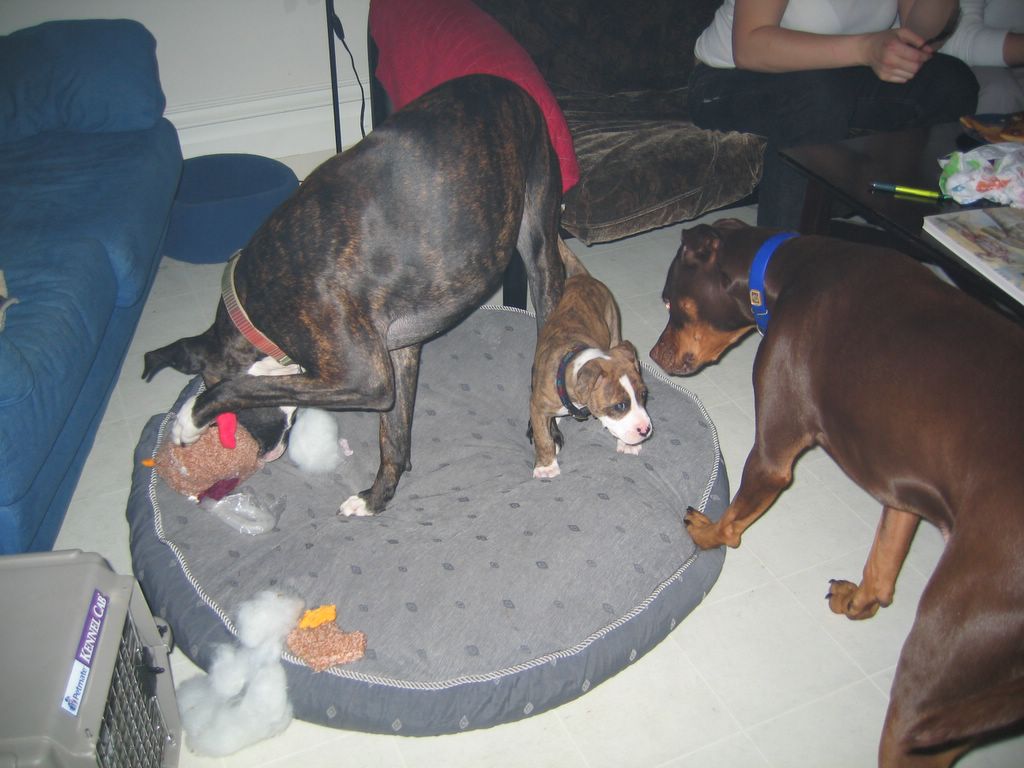
Ripley sniffing the puppy Posted by Picasa

Lake Tahoe Posted by Picasa

Awww Posted by Picasa

Sharing Posted by Picasa